Not Just Black and Not Just White
Not Just Black and Not Just White
My mother and father brought me into this world, but no one gave them a manual on how to raise mixed children.
I was raised by my mother. My father, who was Black, was out of the picture until my adult years. So I grew up in a house where one half of me was mirrored back every day, and the other half was a question I didn’t know how to ask.
Nowadays, there are so many mixed people. You see us everywhere — in commercials, in classrooms, in the family photos on Facebook. But when I grew up, there were very few of us. Often, I was the different one.
White and Black. But not Black enough. And not just White. I lived in the “and.”
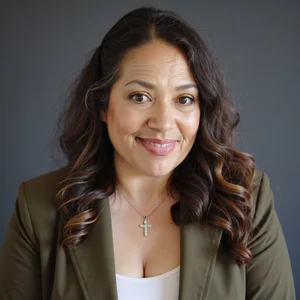
And the “and” lived in my hair.
Curly. Poofy. Wavy. Curly again. A whole weather system on my head. It shrank when it rained. It expanded when I was nervous. It had opinions.
When I flat iron it, I turn into a different version of myself. Sleek. Quiet. More palatable, maybe. I look in the mirror and think, “Oh, there she is — the version people don’t ask questions about.”
I remember wishing I had “Caucasian hair.” Because my hair is a piece of work. And when you’re a kid, you don’t want a piece of work. You want easy. You want to blend in. You want to go swimming without doing math about how long it’ll take to get your hair back to “normal.”
No one told my mother how to navigate that. How do you teach a child to love the hair you don’t understand? How do you answer “What am I?” when the boxes on the form don’t have a space for her? She did her best. She loved me fiercely. But there were gaps, and I fell into some of them.
And no one told my father, either. He was gone, and then he was back when I was grown. By then I’d already answered a lot of those questions alone. I’d already learned to shrink myself or puff myself up depending on the room.
The world wants you to pick. Are you Black? Are you White? Check one box. But I am both. I am the space between. I am the margin where the boxes end.
It took me years to stop wishing my hair away. Now I know: my hair isn’t a problem to solve. It’s an inheritance. It’s proof of both my parents, even when one was absent. It’s proof that I don’t have to choose one half of myself to be whole.
I was raised by my mother. I was shaped by my father’s absence and his later presence. And I raised myself in the in-between.
There are more of us now. More kids who don’t have to be “the only one.” That heals something in me. But I write this for the girl I was — the one with the curly poofy hair who thought “easy” hair meant an easy life.
Your hair is not a piece of work. It’s a piece of your story. And your story doesn’t need to pick a side to be beautiful.
I am not just Black. I am not just White. I am both. I am mine.
And I finally know how to raise her.