Living in the Hypen
Living in the Hyphen
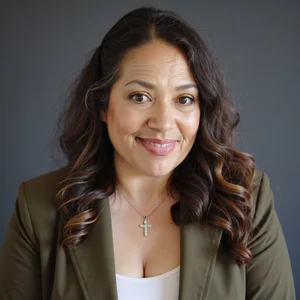
I am both, and I am neither. I am the hyphen between Black and white, and that small line holds a whole world.
Being biracial is not half of one thing plus half of another. It’s a third space. You grow up fluent in two languages of culture, but sometimes feel like a visitor in both. White relatives would touch my hair like it was a curiosity, then ask why I was “so sensitive” about race. Black family would tease me for “talking white,” then tell me the cops would still see me as Black. Both were trying to love me. Both were telling me I didn’t quite belong.
That’s the biracial experience: you see the code-switch before you have words for it. You learn early that America is not colorblind. It’s color-coded, and you confuse the system.
I was born into the aftermath. My parents’ marriage was legal, but not always welcome. Loving v. Virginia was 1967. I’m 51. That means my parents were adults when interracial marriage was still banned in 16 states. That history isn’t ancient. It’s my childhood. It’s the stares in restaurants. The landlord who suddenly had no vacancies. The family members who didn’t come to the wedding and sent their disapproval like an inheritance.
People think racism is a binary: Black experience vs. white experience. But the biracial lens shows you the seams. You watch how the same teacher who praises your “articulate” answers suspends your cousin for the same tone. You sit in church and hear “we’re all God’s children,” then watch the pews self-segregate. You see politics slice people into sides, while you live in the middle and get cut by both edges.
The criminal system taught me this first. I watched relatives get “the talk” about police, but mine came with a footnote: “You might not look it, but they’ll treat you like it.” Then I’d watch a white friend get a warning for the same thing that got my Black friend a record. I was evidence that race isn’t just skin deep. It’s a set of assumptions that attach to you before you speak. And when you’re biracial, those assumptions contradict each other in real time.
Religion was supposed to be the place where we were one body. But I learned hymns in a white choir where no one talked about MLK, and I learned gospel in a Black choir where they prayed for protection from the same towns the other church built. Both prayed to the same God. Both were shaped by a country that taught them they were different kinds of children. I stood between them and realized faith didn’t erase race. Sometimes it baptized it.
Politics now asks me to choose a team. But I’ve lived the policy. Housing discrimination isn’t abstract when your family couldn’t buy on the “good” side of Salem. School tracking isn’t theory when you were the only brown kid in AP classes. “Law and order” doesn’t sound neutral when you’ve seen who gets the order and who gets the law. I don’t have the luxury of single-issue voting because my existence is multiple issues at once.
So what do you do with a life lived in the hyphen? You stop apologizing for it. The gift of being biracial is you can’t be lazy about perspective. You are forced to hold two truths. You know white America isn’t a monolith of privilege, because you’ve seen your white mom work double shifts and get called a race traitor. You know Black America isn’t a monolith of struggle, because you’ve seen your Black dad buy his first house and get followed in it.
Racism continued, yes. It shapeshifted from banned marriages to banned books, from redlining to “school choice,” from “colored” signs to comment sections. But the hyphen continues too. We exist. We marry. We have kids who will have to fill out forms that still make them pick one box. And we tell them: you are not a box. You are the bridge.
I am not half. I am whole. I am the proof that the binary was always a lie. And if America is ever going to heal, it won’t be by picking a side. It will be by learning to live in the hyphen — to hold contradiction, to see the other, to become fluent in someone else’s world without losing your own.
That’s the biracial assignment. And I’m still writing it.
**Cathryn m Harris